The
The Fallow Deer
Common name - fallow deer.
Scientific name - dama dama.
Size - bucks (males) typically range between 70 - 90 kgs and stand at around 1 metre at the shoulder. Does (females, pron. 'doze') are slightly smaller at between 40 - 60 kgs and around 80 cm at the shoulder.
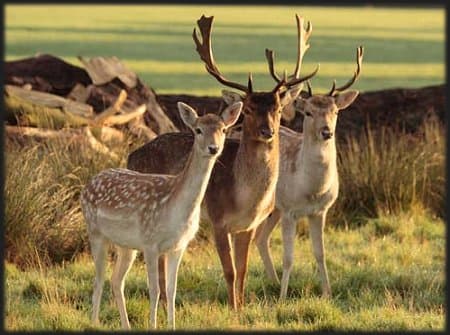
Identification tips - coat colours can vary from very dark brown (almost black) through to a pale chestnut colour and even white in some fallow deer, although these are not true albinos.
As a general rule of thumb, assume the lighter chestnut colour with white spots on the flanks and back of the body over the summer months and the darker coloured coat with few or no spots over the winter months.
A distinguishing feature of the fallow deer is the tail area which shows a black border surrounding a very pale, almost white, area of rump hair. The black often extends along the length of the tail.
Fallow buck antlers are often large and 'palmated' (flattened), unlike the short branched antlers of roe deer.
Preferred habitat - mixed woodland but also graze in open areas where woodland is nearby to provide cover. Heards rarely stay for long in one place, constantly being on the move.
- Diet - a range of vegetation, favouring ground plants such as grass and heather. Fresh shoots of holly and bramble bushes are also eaten along with low hanging shoots of trees such as beech and oak.
Acorns, fallen nuts and fungi are often eaten during the winter months. - Breeding - mating season, called the Rut, begins in mid-September and is over by the end of October. A doe will give birth to a single fawn the following May - June, often in an area of dense vegetation such as bracken.
- Other points - fallow deer are the most prominent in The New Forest (thought to have been introduced into Britain by the Normans) and although easily scared away they can often be seen during a quiet forest walk. If spooked, fallow deer will often only run into the immediate cover and watch from there, rather than disappearing completely.
Mid October is an excellent time to watch fallow deer, when the bucks can be heard making a deep, throaty bark. Caution should be exercised if viewing near a rutting ground as the animals are highly charged at this time of year.