The New Forest and surrounding areas played a huge role during the Second World War (1939-45), and the wartime history is very important to locals of the Forest, not to mention friends and relatives of those who fought during that time and of course the surviving soldiers, seamen and aircrew of the area themselves.
Today, some reminders of the dark days of war are still very much visible in certain areas of the New Forest National Park - from the disused wartime airfields of Beaulieu and Stoney Cross, to the coastal defenses of Hurst Castle and the Lepe Beach/Calshot area.
The wartime history of the New Forest is a huge topic, this page outlines just a handful of examples of areas that played important parts during WWII.
At the height of activity there were no less than 12 airfields and ALGs (Advanced Landing Grounds) in and immediately around the New Forest. Sites included Beaulieu Heath, Stoney Cross, Ibsley, Holmsley and Lymington, as well as Hurn to the west, now Bournemouth International Airport.
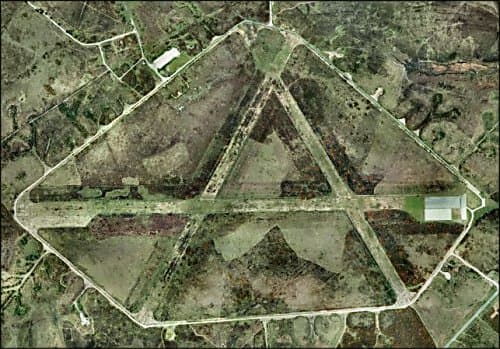
Whereas many sites are now invisible to the human eye, some are still clearly visible, especially from the air.
The thin top soils of the New Forest mean that runways, service roads and building foundations of some wartime airfields have never been reclaimed by nature, and although the Forestry Commission has removed many tarmac and concrete hardstandings, service roads and foundations etc. from places such as Stoney Cross, outlines and evidence of major wartime activity still remains.
[OS grid ref: 2412]
Stoney Cross airfield was one of the larger wartime airfields within the New Forest, and was active between the years 1943 to 1946, with post-war activities continuing until its closure in '48.
Stoney Cross, as with all the New Forest airfields, saw a diversity of aircraft and squadrons during its years of operation. MKI Mustangs, P-38 Lightnings and Hurricanes were the more notable fighters flown from the airfield, while larger bombers and transport aircraft included Wellingtons, Liberators, Stirlings and Albemarles.
From 1944 onwards, Stoney Cross changed role from being a major fighter and bomber base to playing host to Transport Command, and saw many troops flown out to the Middle East.
Today, the main SW/NE (25/07) runway forms the road to Linwood and the Ocknell and Longbeech campsites make use of the airfield service roads and aircraft hardstandings. Only recently, and sadly, the Forestry Commission removed the huge water tower at Longbeech, a familiar landmark and reminder of the airfield.

Above, Stoney Cross today compared with the airfield plan, below. Ocknell campsite clearly visible in the bottom right corner. Explore the airfield in detail (opens new window)

Shown below, a couple of visible reminders of the airfield, and how it looks today...
![]() Base of a runway light | ![]() Hanger door runners |
![]() Memorial plaque on the airfield | ![]() The main runway, now a Forest road |
[OS grid ref: 3501]
Beaulieu, like Stoney Cross, was a major wartime airfield of the New Forest that saw a large amount of action including Coastal Command. Many anti-submarine operations were flown from Beaulieu, an important role in the airfield's history.
Beaulieu airfield has a strong link to the very first days of flying in the New Forest - the New Forest Flying Club was established in 1910 on the other side of the Beaulieu-Lymington road adjacent to the village of East Boldre. Although that site was used during WWI, the need for a larger airfield for WWII meant that that site was no longer suitable and so the new one was built across the road.
Today the distinctive 'A' layout of Beaulieu airfield is clearly visible from the air, and the very eastern end of E/W (09/27) runway is used by radio control model plane enthusiasts, with the original runway concrete and tarmac still remaining.

Above, Beaulieu today compared with the airfield plan, below. The only surviving area of runway tarmac is clearly visible at the eastern end, now in use by radio control aircraft pilots. Explore the airfield in detail (opens new window)

[OS grid ref: 1508]
Ibsley is located on the western edge of the New Forest National Park, midway between Fordingbridge and Ringwood.
It played an important role in the war and was a major base for Spitfire and Typhoon fighters. Today, Ibsley is a water based nature reserve managed by Southern Water and although none of the airfield remains, the control tower does, albeit in a state of disrepair.
Away from the airfield site on a tree-covered hill the remains of Battle Headquarters can still be found, a stark reminder of the area's wartime history.
Ibsley can also boast a movie-making credit - in 1942 the film First of the Few, starring David Niven, was shot on location at the airfield while it was in service. Now a wartime classic, the film follows the story of the legendary Spitfire, its development and its heroic pilots.
![]() The control tower | ![]() Battle headquarters |
![]() The airfield memorial | ![]() Overlooking what was the airfield |
There has been word of the control tower at Ibsley getting renovated, but whether this happens or not remains to be seen. It would be a great memorial if so.
The website of the RAF Ibsley Historic Group is the place to watch for any developments there.
While airfields such as Ibsley, Beaulieu and Stoney Cross have their own memorial plaques, a much larger wartime memorial dedicated to all the servicemen and women (from home and abroad) of the New Forest airfields was uncovered at Holmsley airfield in August 2002:

This memorial is to be found at the western end of Holmsley South airfield, now Holmsley campsite, just off the main A35 Lyndhurst-Christchurch road. The OS grid reference for the memorial is 212989.
Of course, wartime activity within the New Forest didn't stop at airfields.
The Forest itself was in a prime location for military action, and the densely wooded areas provided excellent natural cover from spying eyes.
The area saw its busiest wartime period in the build up to D-Day, and veterans will tell you just how crowded the Forest was at this time.
In some parts, small village roads were widened to accommodate the extra number of tanks and other army vehicles, and temporary camps sprung up everywhere. Foreign, as well as British, troops far outnumbered the local population and the New Forest experienced an incredible feeling of anticipation that something large was about to happen.
D-Day reminders can still be seen off the shores of Lepe Beach, where the large concrete platforms used to construct the famous 'Mulberry Harbours' still exist, alongside beach defences.
Back inland, Ashley Range near Godshill is now a popular spot for walkers but during the wartime years was a large bombing range. The famous 'bouncing bomb' was tested here and today there are many visible clues to this area's activity. From the air, chalk target markings can still be seen and in the south-eastern corner of the range an observation shelter still stands.
The particular area of heathland that is Ashley is littered with craters made from bomb and shell explosions, now providing watering holes for the New Forest ponies and other wildlife.
Below are a few photos of what can be seen at Ashley...
![]() Observation shelter | ![]() Chalk for target marking |
![]() One of many craters | ![]() A larger crater |

Target markings and craters on Ashley Heath, very visible in this modern day aerial shot. Explore present day Ashley Walk in detail
Crash sites were, not surprisingly, a common thing in and around the New Forest during wartime. With such a high concentration of young and inexperienced pilots in a small area, mid-air collisions and crashes were inevitable as well as the shooting down of many many aircraft over the Forest.
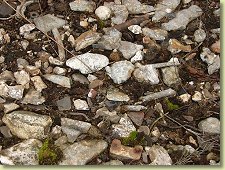
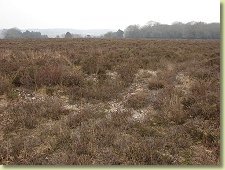
Remarkably some crash sites can still be found, and the ground was damaged by the explosions so much that vegetation was not able to regenerate. Bare patches of the underlying gravel amongst the heather are a tell-tale sign of such sites, and pieces of melted airframe, perspex and even bullet casings can still be recovered from such areas today.
The photos below show one such site, believed to be an Armstrong Albermarle that got into difficulties while on a routine parachute training exercise out of Stoney Cross...
![]() | ![]() |
Above, an unassuming area of missing heather (left) but look closely and many small fragments of aircraft remains can still be found (right) in the gravel
RAF Iblsey Historic Group
Friends Of The New Forest Airfields

The New Forest at War is an excellent book all about the New Forest wartime history. Filled with accounts told by local servicemen and residents, the book details all aspects of Forest life during the Second World War and contains many unique photos from the time.
Available from Amazon, this book is a must for anyone interested in the Forest and its military past.